
Neville D’Souza: The Catholic Football Hero Whose Bandra Ground Now Faces the Whistle of Demolition – Catholic Connect
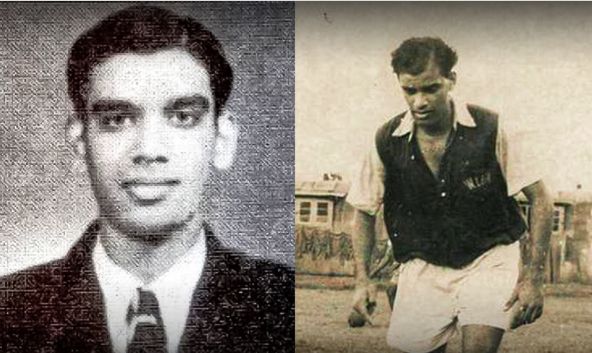
Mumbai, August 19, 2026: For generations of Indian football lovers, the name Neville D’Souza has belonged to one of the country’s most remarkable sporting stories. Now, the football ground in Bandra Reclamation that bears his name faces an uncertain future, with the Brihanmumbai Municipal Corporation (BMC) proposing to change the site’s reservation for a convention and exhibition centre.
The controversy has brought in protest from the public. But behind the dispute is the story of a remarkable sportsman whose achievements helped place Indian football on the international stage.
From Hockey to Football
Neville Stephen Joseph D’Souza was born on 3 August 1932 and died on 16 March 1980, aged 47.
His sporting journey began with field hockey. He represented St Xavier’s High School and St Xavier’s College in Bombay before playing for Tata Sports Club. During a 1952 tour of East Africa, he scored an extraordinary 34 goals in 17 matches. He also represented Bombay in the National Hockey Championship.
Football eventually became his calling. D’Souza played for Goans Sports Club and Tata Sports Club before joining Caltex SC. With Caltex, he was part of the team that won the 1958 Rovers Cup, defeating Mohammedan Sporting 3–2 in the final.
The Olympic Hero of Melbourne
D’Souza’s defining achievement came at the 1956 Melbourne Olympics, when India reached the semi-finals and finished fourth — still the country’s best Olympic result in men’s football.
In the quarter-final against Australia, D’Souza scored a sensational hat-trick. He became the first Asian footballer to score a hat-trick at the Olympic Games, finishing the tournament with four goals in three matches and as joint top scorer.
India eventually lost to Yugoslavia in the semi-final, but D’Souza had already secured his place in Indian sporting history. His international career also included appearances in the Asian Quadrangular Football Tournament, including a goal against Pakistan in 1953.
A Goan Catholic Sporting Legacy
D’Souza was born in Assagao, Goa, to Jose and Alina D’Souza. His journey from Goa to Bombay reflected the close sporting links between the two places and the important role played by the Catholic community in nurturing sport.
His education at St Xavier’s High School and St Xavier’s College placed him within a Catholic educational tradition that valued discipline, character and sporting excellence. These institutions helped shape generations of young athletes, and D’Souza’s career became one of their most remarkable sporting stories.
His Catholic identity was also rooted in family life. He married Lyra D’Souza, and they had three children — Nigel, Liesel and Fleurel. His brother Derek D’Souza also represented India in football.
After Neville’s death, Lyra remained an important keeper of his memory, recalling the footballer whose achievements had once made him a household name among Indian sporting followers.
His story is therefore not only about medals and goals. It is also the story of a husband, father and brother whose family and community were part of the life behind the sporting legend.
A Ground in His Name
The Neville D’Souza Football Ground at Bandra Reclamation became a fitting tribute to his contribution to Indian football.
The ground has hosted Mumbai Football Association competitions involving men’s, women’s and youth teams, giving thousands of aspiring footballers a place to train and compete.
For many young players, Neville D’Souza is no longer simply a name from India’s sporting past. His name is attached to the place where they play.
That makes the ground a living memorial.
When a Tribute Becomes a Battleground
In June 2026, the BMC Improvements Committee approved a proposal to alter the reservation of the approximately 8,450-square-metre site, changing its designated use from a sports ground and playground to an exhibition or convention centre.
Footballers, coaches, parents and residents have strongly opposed the proposal, pointing to Mumbai’s shortage of football grounds. The Mumbai Football Association has warned that losing the facility would deprive thousands of players of an important venue.
The Bombay High Court has also moved up the hearing of a petition challenging the proposal, while civic officials have argued that the land was originally intended for a public convention facility.
More Than a Patch of Grass
The debate is ultimately about more than land. It is about what Mumbai chooses to remember.
Neville D’Souza’s journey — from a Goan Catholic family and Bombay’s sporting institutions to the Olympic stage — represents an important chapter in India’s sporting history.
A convention centre may serve a civic purpose. But a football ground gives children somewhere to play, young athletes somewhere to dream and communities somewhere to gather.
The ground may be threatened by demolition. Neville D’Souza’s legacy should not be.
The goalposts may one day disappear and the floodlights may fall silent. But the story of the footballer who scored an Olympic hat-trick for India should remain.
The ground may be erased from the map, but Neville D’Souza should never be erased from the memory of Indian sport.